Planning to Visit the Philippines Soon?

There are hundreds of tourists attractions in the Philippines. But as a lover of the Island of Marinduque (Home of the Morions and Heart of the Philippines), I am indeed partial to its beauty, charm and its friendly and hospitable residents. Therefore, help me achieve my dream of seeing this island becomes a world tourist destination, by telling all your friends and relatives about this site. Welcome, to you all, new readers and faithful followers of this site! The photo above is Poctoy White Beach in Torrijos, Marinduque with beautiful and majestic Mt Malindig in the background. Some of the photos and videos on this site, I do not own. However, I have no intention on infringing your copyrights.

Tuesday, December 14, 2021

Some of My Favorite Quotes on Kindness, Generosity and Compassion

Last week, my Italian-American neighbor visited me and brought with her Apple sauce she just prepared and Pasta. In returned, I gave her a big slice of smoke ham. She like the ham so much, she requested if I have another small slice. She said it reminded her of the ham in Italy during her childhood years. This act of Kindness reminded me of an article I wrote about some of my favorite quotes on Kindness, Generosity and Compassion.

"Just recently I wrote in my blogs an act of kindness I received from a young teenager in our neighborhood. In that article, I also referenced 4 act of kindness that my family and I experienced during the last 6 decades both here in the US and in the Philippines. 

https://lifeinus1960present.blogspot.com/2021/09/an-act-of-kindness-from-young-stranger.html

Today, I am listing 20 of my favorite quotes as follows:    

 Quotes on Kindness and Generosity

  1. Sometimes it takes only one act of kindness and caring to change a person’s life.” – Jackie Chan
  2. Do things for people not because of who they are or what they do in return, but because of who you are.”Harold S. Kushner
  3. Carry out a random act of kindness, with no expectation of reward, safe in the knowledge that one day someone might do the same for you.” – Princess Diana
  4. “Because that’s what kindness is. It’s not doing something for someone else because they can’t, but because you can.” Andrew Iskander
  5. Remember there’s no such thing as a small act of kindness. Every act creates a ripple with no logical end.”Scott Adams

kindness-quotes

Motivational Quotes

  1. Love and kindness are never wasted. They always make a difference. They bless the one who receives them, and they bless you, the giver.” – Barbara De Angelis
  2. What wisdom can you find that is greater than kindness?” – Jean-Jacques Rousseau
  3. You can accomplish by kindness what you cannot by force.” – Pubilius Syrus
  4. Kindness can become its own motive. We are made kind by being kind.” – Eric Hoffer
  5. Human kindness has never weakened the stamina or softened the fiber of a free people. A nation does not have to be cruel to be tough.” Franklin D. Roosevelt

kindness-quotes

Compassion Quotes

  1. “We can’t help everyone, but everyone can help someone.” – Ronald Reagan
  2. “Kindness begins with the understanding that we all struggle.” – Charles Glassman
  3. “A single act of kindness throws out roots in all directions, and the roots spring up and make new trees.” – Amelia Earhart
  4. “Wherever there is a human being, there is an opportunity for a kindness.” – Lucius Annaeus Seneca
  5. “Unexpected kindness is the most powerful, least costly, and most underrated agent of human change.” – Bob Kerrey

kindness-quotes

Not listed in the above quote is Mark Twain's:

Kindness is an act that the blind can see and the Deaf can Hear!

For additional quotes visit: https://www.ftd.com/blog/celebrate/kindness-quotes

Note: World Kindness Day this Year WAS LAST November 13.

Meanwhile enjoy this photo:


Sunday, December 12, 2021

Creating Small Flower Arrangements for your Christmas Decor

Today, starts the 3-day most- welcome rains/snow  for Northern California. Outside is gloomy and rainy, but inside is cherry and bright with my two flower arrangements I made today and yesterday.

All materials are from my garden-Today's flower arrangement 

Last Thanksgiving Day, I received a Thanksgiving Bouquet from Ditas that was purchased commercially ( second photo). Yesterday, I attempted to copy it creating a small Christmas Center Piece using most of the materials from my Garden. Here's what I created. 


My own simple Christmas Flower Arrangement from Materials in My Garden
A Commercial Thanksgiving Flower Arrangement I received on Thanksgiving Day
 

Remember that the main rules of flower arrangements is to aim for balance, proportion and scale, unity, harmony, rhythm and balance, and emphasis. The words symmetry, contrast, focus, movement, structure, color and subject of the arrangement are often mentioned in designing an arrangement. If you have not done flower arrangement try it. I am pretty sure you will have fun.  

Here's a video of designing a small flower arrangement piece using a discarded gift box as the base.


My two latest arrangement from materials in my Garden this Year


Friday, December 10, 2021

Playing with Numbers, Palindromes and Ambigram


Last December 2, 2021 date if written as "12022021" is not only a palindrome (the same front to back) but it’s also an ambigram which means it’s the same upside down as well! 


The above date was published in my FB page just recently for Nerds Alert. However, it aroused my interest on playing with Numbers,Palindromes and ambigram. A palindrome is a word, sentence, number, phrase, or other sequence of characters which reads the same backward as forward, such as madam, radar or racecar

There are also numeric palindromes, including date/time stamps using short digits 11/11/11, 11:11 and long digits 02/02/2020. Sentence-length palindromes ignore capitalization, punctuation, and word boundaries.Here's a short video on palindromic numbers.

What do you mean by playing with numbers?

Playing with numbers involves activities like arranging the numbers, understanding BODMAS rule*, finding out whether a given number is a factor of another number or a multiple of another number, understanding the properties of factors and multiples. Also, it involves learning how to use an index or exponent for a number, simplification of brackets, multiples and factors, divisibility rules from 2 to 11, the concept of co-prime numbers and prime factorization, finding HCF and LCM, etc.,

*The BODMAS rule states we should calculate the Brackets first (2 + 4 = 6), then the Orders (52 = 25), then any Division or Multiplication (3 x 6 (the answer to the brackets) = 18), and finally any Addition or Subtraction (18 + 25 = 43).

Example of Playing with Numbers:

There are several tricks with numbers to test divisibility by other numbers.

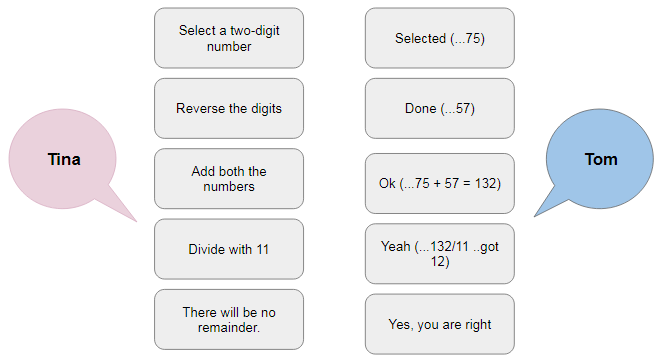
Reversing the digits of a two-digit number

Game with two-digit numbers

Similarly, we can try reversing the digits for dividing by 9.

Selecting a two-digit number: 25

Reversing the digits: 52

Subtract: 52-25 = 27

Divide by 9: 27/9 = 3

Remainder is 0.

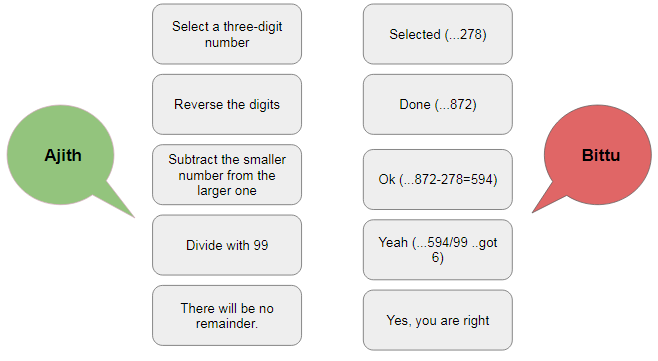
Reversing the digits of a three-digit number

Game with three-digit numbers

Forming three-digit number from the given three digits

For a given three-digit number, rearrange the digits such that all the three numbers are distinct and add them all. Then dividing it by 37, the remainder is always 0.

For example, assuming a three-digit number 124.

On rearranging the digits: 241 and 412.

Add all the three numbers: 124 + 241 + 412 = 777

Divide 777 by 37: 777/37 = 21; remainder is 0.

For complete details read:

 https://byjus.com/maths/playing-with-numbers/ and also wikipedia

Meanwhile enjoy this photo of my creation of a Christmas arrangement table center piece, from materials taken in my Garden this year.


Wednesday, December 8, 2021

The 80th Anniversary of the Bombing of Pearl Harbor

Photo Credit: Joel Cuello, Ph.D.

Yesterday's 80th anniversary of the bombing of Pearl Harbor reminded of my memories of the world War II as a child growing up in Panay Island, Philippines. The war has affected million of lives all over the world including my own. I sometimes wonder what my life would have been if Pearl Harbor was not bombed. I would have not been able to experience my childhood years in the small town where my mother was born. I would have been raised in a modern small city with all the conveniences and not knowing how to survive in the jungles of Panay Island without running water and electricity. 

 Again this year to celebrate this 80th anniversary of the start of WW II, I am reposting the following article for your reading pleasure. If you have read this before, my apologies, but remember There are no winners in war, all are losers.     

"Childhood Memories of the Japanese-American War in the Philippines"

The Bataan Death March

"War is a terrible thing to happen. Few among us have heard the stories of civilians in the war zones. I saw and lived the anxieties and horrors of the Japanese-American war through the eyes of a child. This article (Part 1 of the trilogy) received the ViewsHound Gold Prize of $50 in 2011. ViewsHound is now a defunct writing site formerly based in UK.

Life in the time of war is a difficult experience for a child. All school and play activities are interrupted. Survival amidst the chaos becomes a paramount goal in life. Our family had to uproot ourselves from the comfort of home and move several times to the hard life in the countryside. We had to avoid the conflict and the bombing in the city.

We chose a life of peace and quiet away from the invading Japanese troops. Due to the language barrier, the Japanese instilled order and dominance of the conquered using fear, by hurting or killing innocent civilians, resulting in the rise of the resistance movement. For every day that passes, there was the dream of peace, but during the lengthy war period, one had to expect the worst before anything good happened.

Before the war started, we lived a comfortable life in our home in the city of Jaro, Iloilo located in the central Philippine island of Panay. My father had a dental practice and we had our farm landholdings around the province. It was 13 days before my 7th birthday when the Japanese bombed Pearl Harbor in Hawaii in the morning of December 7, 1941.

On that evening, Japanese planes had taken off to attack several targets in the Philippines, which was then an American colony. It was the start of the Japanese invasion of the Philippines, and the reign of fear was about to begin.

I was in 2nd grade at the Jaro Elementary School when Japan started bombing the bigger cities of the country. When we heard the terrifying news, my parents became concerned for our safety and decided to get out of the city, a possible bombing target.

They chose to move to our farm in the small town of Barotac Viejo, Iloilo, my mother’s ancestral town 60 kilometers north of Jaro. It was a time of panic, chaos and fear over what was to happen in the city. We were about to leave our cherished home and anxiously head to the unfamiliar and unknown.

Within a couple of days all the essential items we could bring were already packed. All the furniture and the huge and heavy items were left behind. My mother had all her china and silverware buried in the backyard for safekeeping.

We found out later that our house was bombed and totally destroyed. All the furniture were either destroyed or stolen. All the china and silverware was dug up and stolen. Despite the losses, we were grateful that we made a wise decision and survived unharmed.

For a short period we settled in a small farm house of our tenant in a remote district of town. As the war progressed, we were informed that the Japanese forces had penetrated most of the big cities in the country and were starting to occupy smaller towns. My father was a captain and dental officer of the newly organized Philippine guerrillas, an underground resistance movement to fight the Japanese. As a precaution, he decided to move our family a second time, to the jungle in the interior of Panay Island.

We had to walk for three days through the woods of the jungle, cross over numerous creeks and climb over mountains with the help and guidance of our farmer tenants. Our trek ended and we settled in a hidden valley lined by a creek with clean running water. Our tenants built us a hut for shelter made of bamboo and nipa palm, an outdoor kitchen and a dining area.

They used a bamboo cart pulled by a water Buffalo to bring us supplies of rice, salt, sugar and other spices regularly. In the valley we cleared the land to plant vegetables, corn and sweet potatoes. We also raised chickens and ducks for eggs, pigs for protein and goats for milk.

One of the scariest events while living in the jungle was when our pig livestock were preyed upon by a python snake measuring about 30 feet long. It was pitch black at night when we heard our two pigs squealing out loud in fear. My father instructed our helper to inspect the pig pen using a kerosene lamp. He saw the snake strangling one of the pigs. He struck and killed the python using his machete and a piece of wood, sadly, our small pig also died. That whole week we had protein in our meals. It was proof that the jungles of Panay are inhabited by dangerous pythons.

We had no pet with us. I chose the chickens and the goats to become my pets. I raised one of the chickens; it slept with me, got attached to me and kept trailing me wherever I go. My mother tolerated my unusual pets because I had no peers my age aside from my younger brother.

To continue with our education, my father home schooled us together with two of my older cousins. For four hours each day we were taught arithmetic, spelling and history. We were lucky to have brought with us a few books on Philippine and US history. Whenever our tenants brought us food supplies, they would update us on news about the status of the Japanese occupation.

Late in the war when the Japanese brutality and atrocities appeared to have stopped, we moved again from the jungle to a seaside village. We stayed at the house of another tenant. My father warned us not to talk to any stranger, and if asked, to avoid giving our real last name of Katague and instead provide an alias which was Katigbak. There were unverified rumors that the Japanese had a list of names of all the guerrillas, which might have included my father. Some traitor Filipinos worked as spies for the Japanese by pinpointing the guerrillas in exchange for favors.

One day, we saw a platoon of uniformed Japanese soldiers armed with guns and bayonets passing by our village. My brother and I watched them march while hiding in the bushes. I knew their brutal reputation towards the natives, and I was afraid of us being seen and getting in trouble. I was relieved that nothing happened and they continued with their march to the next village.

A terrible incident happened to about 30 of my maternal relatives while we were living in the jungle. They were similarly hiding and living in the jungle on a mountain ridge next to us. They were killed by the Japanese soldiers who discovered and penetrated their location with the help of the spies. A handicapped relative in a wheelchair was spared. During the massacre, she fell on the creek and must have been left for dead. She lived to tell the tragic story. This is only one example of many atrocities that was committed by the Japanese to the Filipino civilians.

When General MacArthur landed in Leyte on October 1944, it was the happiest day for the Filipinos, the Americans were back to save us from the Japanese tyranny. The Japanese troops started to retreat and surrender. The chance for peace in the Philippines was welcomed with excitement. The schools were planning to reopen. There was no more need to live in hiding and in fear, and to lie about one’s name. We were able to live free from the oppressors.

From the seaside village we moved to another district much closer to town where we built a bigger house. At the back of the property was a hill, and on a clear day, from the top of the hill you could see the nearby island of Negros. We used it as an observation hill where we could watch the Japanese and American planes flying and then fighting each other. My brother and I witnessed two planes attacking each other, with one plane being blown to pieces and burning as it fell from the sky to the sea between Panay and Negros islands. It was a thrilling dogfight show to watch, although we never found out the victor.

When school reopened, we were required to take a test to determine which grade level we would qualify for. I passed the test for a 4th grade level. I was merely in grade 2 when war broke out. In short, I completed six grades of elementary in only four years of schooling. In class, I was two years younger than most of my classmates. I was thankful for the result of my father’s patience in home schooling us while living in the jungle. At last we were able to go back to our school, new home, and live the life of what was left of my childhood years in peace.

Always remember that there are no winner of wars. Everybody are losers!!"


Monday, December 6, 2021

Development of New Drugs in the US- An Update

Today's news of President Biden Plan on lowering drug prescription costs reminded me of my article about drug development in the US.


I wrote this article a decade ago today. I believe the contents of this article is still valid today except the costs and success rate.

Development of New Drugs in the United States Schematic

Image from medscape.com

As a retired FDA involved in the development of new drugs in the Division of Anti-Infective Drug Products, Office of New Drug Chemistry, I had often been asked by several of my blog readers to write a summary and an overview of new drug development in the US. I had been postponing it, because I thought the subject is confidential, but when I started browsing in the WEB today, I found several articles on the subject. I even found a Chemistry manufacturing supplement that I had approved several years ago. The letter of approval and the chemist review was printed in the Internet. However, the specifics of the supplement was erased in the approval letter as well as in the chemist review. The patent of the drug discussed had expired, so it is open to generic companies, otherwise the chemist review and letter of approval will never be made public. I am getting out of the subject, but let me start on the subject right now.

New Chemical Entity (NCE) development

Broadly the process can be divided into pre-clinical and clinical work.

Pre-clinical.

New Chemical Entities (NCEs)(also known as New Molecular Entities (NMEs)) are compounds which emerge from the process of drug discovery. These will have promising activity against a particular biological target thought to be important in disease; however, little will be known about the safety, toxicity, pharmacokinetics and metabolism of this NCE in humans. It is the function of drug development to assess all of these parameters prior to human clinical trials. A further major objective of drug development is to make a recommendation of the dose and schedule to be used the first time an NCE is used in a human clinical trial ("first-in-man" (FIM) or First Human Dose (FHD)).

In addition, drug development is required to establish the physicochemical properties of the NCE: its chemical makeup, stability, solubility. The process by which the chemical is made will be optimized so that from being made at the bench on a milligram scale by a synthetic chemist, it can be manufactured on the kilogram and then on the ton scale. It will be further examined for its suitability to be made into capsules, tablets, aeresol, intramuscular injectable, subcuteneous injectable, or intravenous formulations. Together these processes are known in preclinical development as Chemistry, Manufacturing and Control (CMC).

Note: The CMC portion of was my primary function as the Team Chemistry Leader during my employment with FDA

Many aspects of drug development are focused on satisfying the regulatory requirements of drug licensing authorities. These generally constitute a number of tests designed to determine the major toxicities of a novel compound prior to first use in man. It is a legal requirement that an assessment of major organ toxicity be performed (effects on the heart and lungs, brain, kidney, liver and digestive system), as well as effects on other parts of the body that might be affected by the drug (e.g. the skin if the new drug is to be delivered through the skin). While, increasingly, these tests can be made using in vitro methods (e.g. with isolated cells), many tests can only be made by using experimental animals, since it is only in an intact organism that the complex interplay of metabolism and drug exposure on toxicity can be examined.

The information gathered from this pre-clinical testing, as well as information on CMC, and is submitted to regulatory authorities (in the US, to the FDA), as an Investigational New Drug application or IND. If the IND is approved, development moves to the clinical phase.

Clinical phase.

Clinical trials involves three steps: Phase I trials, usually in healthy patients, determine safety and dosing Phase II trials are used to get an initial reading of efficacy and further explore safety in small numbers of sick patients Phase III trials a large, pivotal trials to determine safety and efficacy in sufficiently large numbers of patients

The process of drug development does not stop once an NCE begins human clinical trials. In addition to the tests required to move a novel drug into the clinic for the first time it is also important to ensure that long-term or chronic toxicities are determined, as well as effects on systems not previously monitored (fertility, reproduction, immune system, etc.). The compound will also be tested for its capability to cause cancer (carcinogenicity testing).

If a compound emerges from these tests with an acceptable toxicity and safety profile, and it can further be demonstrated to have the desired effect in clinical trials, then it can be submitted for marketing approval in the various countries where it will be sold. In the US, this process is called a New Drug Application or NDA. Most NCEs, however, fail during drug development, either because they have some unacceptable toxicity, or because they simply do not work in clinical trials.

As this drug discovery process becomes more expensive it is becoming important to look at new ways to bring forward NCEs. One approach to improve efficiency is to recognize that there are many steps requiring different levels of experimentation. The early phase of drug discovery actually has components of real innovation, components of experimentation and components that involve set routines. This model of Innovation, Experimentation, and Commoditization ensures that new ways to do work are adopted continually. This model also allows the discipline to use appropriate internal and external resources for the right work.

Costs

Studies published by diMasi et al in 2003 report an average pre-tax cost of approximately $800 million to bring a new drug (i.e. a drug with a new chemical entity) to market. A study published in 2006 estimates that costs vary from around $500 million to $2 billion depending on the therapy or the developing firm. A study published in 2010 in the journal Health Economics, including an author from the US Federal Trade Commission, was critical of the methods used by diMasi et al but came up with a higher estimate of ~$1.2B. Critic Marcia Angell, M.D., a former editor of the New England Journal of Medicine, has called that number grossly inflated, and estimates that the total is closer to $100 million. A 2011 study also critical of the diMasi methods, puts average costs at $55 million.

Success rate

Candidates for a new drug to treat a disease might theoretically include from 5,000 to 10,000 chemical compounds. On average about 250 of these will show sufficient promise for further evaluation using laboratory tests, mice and other test animals. Typically, about ten of these will qualify for tests on humans. A study conducted by the Tufts Center for the Study of Drug Development covering the 1980s and 1990s found that only 21.5 percent of drugs that start phase I trials are eventually approved for marketing. Now you know why the drugs you purchased in the pharmacy is very expensive ( except the generic drugs). Most Americans will not be able to afford new drugs if they do not have insurance.

The mission of FDA is to enforce laws enacted by the U.S. Congress and regulations established by the Agency to protect the consumer's health, safety, and pocketbook. The Federal Food, Drug, and Cosmetic Act20 is the basic food and drug law of the U.S. With numerous amendments it is the most extensive law of its kind in the world. The law is intended to assure consumers that foods are pure and wholesome, safe to eat, and produced under sanitary conditions; that drugs and devices are safe and effective for their intended uses; that cosmetics are safe and made from appropriate ingredients; and that all labeling and packaging is truthful, informative, and not deceptive.Code of Federal Regulations (CFR)

Code Of Federal Regulations (CFR)21. The final regulations published in the Federal Register22 (daily published record of proposed rules, final rules, meeting notices, etc.) are collected in the CFR. The CFR is divided into 50 titles that represent broad areas subject to Federal regulations. The FDA's portion of the CFR interprets the The Federal Food, Drug, and Cosmetic Act23 and related statutes. Section 21 of the CFR24 contains most regulations pertaining to food and drugs.

Note: I hope you found the above posting informative. My next posting on this subject will be on the Chemistry, Manufacturing and Control(CMC) Requirements for IND's and NDA's. If you find this posting either boring or interesting, let me know via comments. Thank You.

 Comment:

Anonymous said...You have a very informative article, I hope the FDA does not condone your site for writing about their business. Would you know how much the FDA charges drug companies for testing each of their new drugs from start to finish? This must cost them a bundle because, FDA employs a plethora of highly educated doctors, scientists, mathematicians and business people. Jeffrey Ray


A very interesting interview about the development of new drugs by Dan Skovronsky, Director of Research and Development, Eli Lily. 
 
Meanwhile enjoy this photo from my collection-My Pineapple in my front Patio almost ready to be harvested.


Thursday, December 2, 2021

My Twenty-Five Favorite Quotes on Thankfulness and Gratitude

My Twenty Five Favorite Quotes on Gratitude and Thankfulness

Last week was my 61 years of experiencing the Thanksgiving Holiday here in the US. It reminded me of my favorite quotes on Thankfulness and Gratitude I am posting today.
 
Here are 25 quotes about gratitude and thankfulness that will not only remind you that what you have is pretty awesome, but will also, I hope, spur you to express that gratitude to the people who deserve it most.
  1. "Feeling gratitude and not expressing it is like wrapping a present and not giving it." William Arthur Ward
  2. "I would maintain that thanks are the highest form of thought; and that gratitude is happiness doubled by wonder." G.K. Chesterton
  3. "'Enough' is a feast. Buddhist proverb
  4. "If you count all your assets, you always show a profit." Robert Quillen
  5. "Enjoy the little things, for one day you may look back and realize they were the big things." Robert Brault
  6. "As we express our gratitude, we must never forget that the highest appreciation is not to utter words but to live by them." John F. Kennedy
  7. "Reflect upon your present blessings, of which every man has plenty; not on your past misfortunes, of which all men have some." Charles Dickens
  8. "Acknowledging the good that you already have in your life is the foundation for all abundance." Eckhart Tolle
  9. "If a fellow isn't thankful for what he's got, he isn't likely to be thankful for what he's going to get." Frank A. Clark
  10. "If you want to turn your life around, try thankfulness. It will change your life mightily." Gerald Good
  11. "Gratitude turns what we have into enough, and more. It turns denial into acceptance, chaos into order, confusion into clarity...it makes sense of our past, brings peace for today, and creates a vision for tomorrow." Melody Beattie
  12. "The world has enough beautiful mountains and meadows, spectacular skies and serene lakes. It has enough lush forests, flowered fields, and sandy beaches. It has plenty of stars and the promise of a new sunrise and sunset every day. What the world needs more of is people to appreciate and enjoy it." Michael Josephson
  13. "Gratitude is a currency that we can mint for ourselves, and spend without fear of bankruptcy." Fred De Witt Van Amburgh
  14. "The way to develop the best that is in a person is by appreciation and encouragement." Charles Schwab
  15. "He is a wise man who does not grieve for the things which he has not, but rejoices for those which he has." Epictetus
  16. "At times, our own light goes out and is rekindled by a spark from another person. Each of us has cause to think with deep gratitude of those who have lighted the flame within us." Albert Schweitzer
  17. "The deepest craving of human nature is the need to be appreciated." William James
  18. "Be thankful for what you have; you'll end up having more. If you concentrate on what you don't have, you will never, ever have enough." Oprah Winfrey
  19. "Let us rise up and be thankful, for if we didn't learn a lot today, at least we learned a little, and if we didn't learn a little, at least we didn't get sick, and if we got sick, at least we didn't die; so, let us all be thankful." Buddha
  20. "Silent gratitude isn't very much to anyone." Gertrude Stein
  21. "Thankfulness is the beginning of gratitude. Gratitude is the completion of thankfulness. Thankfulness may consist merely of words. Gratitude is shown in acts." Henri Frederic Amiel
  22. "You cannot do a kindness too soon because you never know how soon it will be too late." Ralph Waldo Emerson
  23. "When I started counting my blessings, my whole life turned around." Willie Nelson
  24. "It is impossible to feel grateful and depressed in the same moment." Naomi Williams
  25. "One can never pay in gratitude; one can only pay 'in kind' somewhere else in life." Anne Morrow Lindbergh

 https://www.inc.com/jeff-haden/40-inspiring-motivational-quotes-about-gratitude.html

Meanwhile enjoy this photo:


 A Thanksgiving Bouquet. It is one week old today, but still look fresh!


Link within

Related Posts Plugin for WordPress, Blogger...